Puerto Rico Flag Meaning: History, Colors and How to Carry It With You
What the stripes, triangle and star of the Puerto Rico flag mean, its history since 1895, the light-blue versus dark-blue debate, and simple ways to carry it with you.

Few symbols stir as much pride as the Puerto Rico flag. It hangs from balconies in Old San Juan, rides on car mirrors, fills the parades in New York, and travels on the caps of those who live far from the island. Behind its five stripes, triangle and star is more than a century of history.
This guide covers the Puerto Rico flag meaning, where it comes from, the debate over its shade of blue, and simple ways to carry it with you every day.
What the Puerto Rico flag looks like
The flag has five horizontal stripes of equal width alternating red and white: three red and two white, starting and ending with red. At the hoist is a blue equilateral triangle whose base spans the full height of the flag, with a white five-pointed star in its center.

What the colors of the Puerto Rico flag mean
There's no single reading everyone agrees on, and several interpretations have built up over time. These are the most cited:
- The red stripes stand for the blood of those who fought for the island. In the reading adopted in 1952, they symbolize the blood that nourishes the three branches of government.
- The white stripes stand for individual liberty and the rights of the people.
- The triangle is associated with the ideals of liberty, equality and fraternity, or with the three branches of government: executive, legislative and judicial.
- The star represents Puerto Rico.
History of the Puerto Rico flag
Today's design was born in 1895 in New York, within the committee of Puerto Rican exiles working alongside the Cuban independence movement. It was inspired by the Cuban flag with the colors reversed: where Cuba's has blue stripes and a red triangle, Puerto Rico's has red stripes and a blue triangle. Its authorship is debated; names often mentioned include Antonio Vélez Alvarado and Francisco Gonzalo "Pachín" Marín.
An earlier flag came first: the flag of the Grito de Lares, from 1868, still seen at cultural events and in the town of Lares.
For much of the 20th century, displaying the flag was politically charged. Between 1948 and 1957, Law 53—known as the Gag Law (Ley de la Mordaza)—went as far as banning it. In 1952 it was adopted as Puerto Rico's official flag, and it has flown over public buildings, schools and homes across the island ever since.
Light blue or dark blue?
The 1952 law didn't set an exact shade of blue. For years the government used a dark blue similar to the U.S. flag, while many favor the light blue, or sky blue, associated with the original 1895 design. Both versions are seen on the island and in the diaspora today, and for many people the choice says something about who's flying it.
The Puerto Rico flag in the diaspora
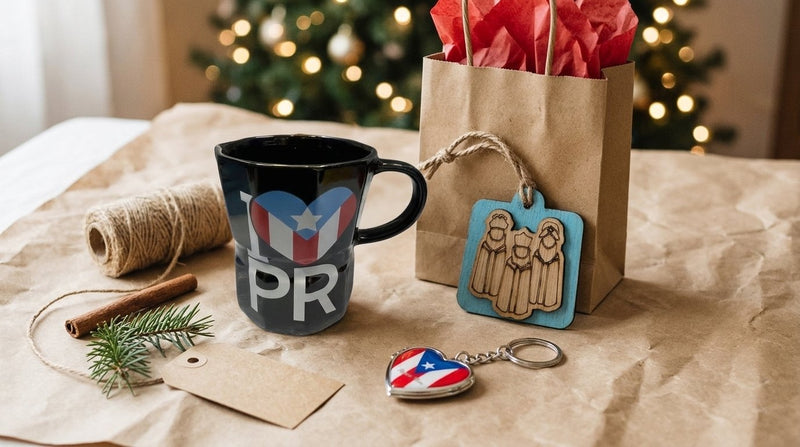
For the millions of Puerto Ricans living in the United States, the flag is a way to carry the island with them. Every June, on the second Sunday, the National Puerto Rican Day Parade fills Fifth Avenue in New York with flags, and cities like Chicago, Orlando and Philadelphia hold their own celebrations. Beyond the parades, the flag shows up in everyday things: the keychain, the cap, the coffee mug.

How to carry the Puerto Rico flag with you
Here are simple ways to keep the flag close every day, on the island or off it:
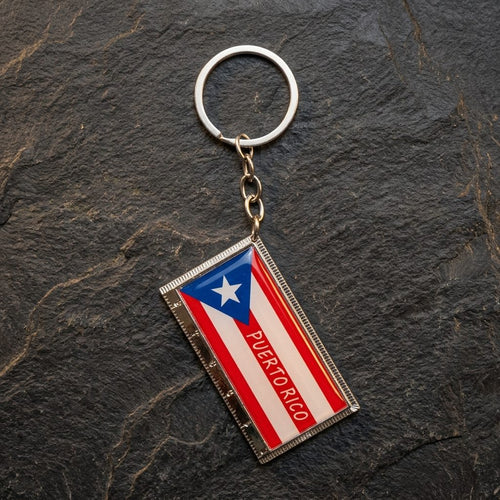
- Keychains: our Puerto Rico flag keychains in 13 styles include heart, bottle-opener and rectangular designs, and the metal flag keychains are an affordable favor to hand out.
- Caps: "Puerto Rico" caps in several colors, and more styles in Puerto Rican apparel and caps.
- For work: the Puerto Rico flag lanyard for your ID or keys, and the wooden desk organizer with the flag or "I ❤ PR."
- To wear: the white Puerto Rico T-shirt in four designs.
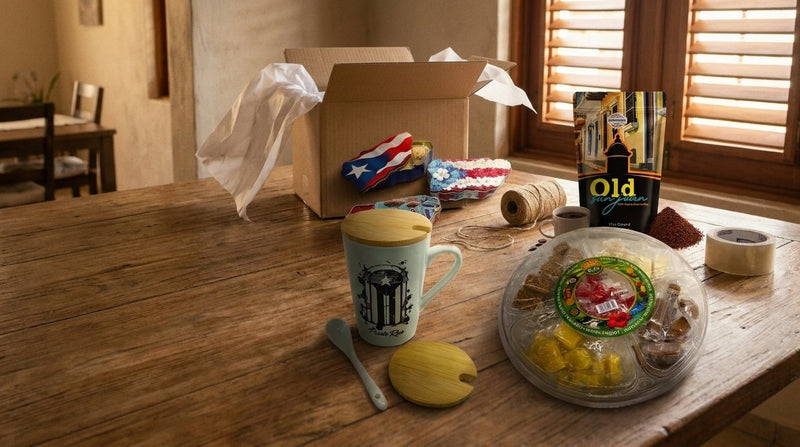
They also make thoughtful gifts for someone who moved away. Find more ideas in our guide to Puerto Rico souvenirs, and to explore the island's culture, visit Puerto Rico from the Heart.
A note of respect: when a flag wears out or tears, retire it with care rather than leaving it on the ground or in the trash.
Puerto Rico flag FAQ
How many stripes does the Puerto Rico flag have?
Five: three red and two white, alternating, starting and ending with red.
What does the star on the Puerto Rico flag mean?
It represents Puerto Rico.
Why does it look like the Cuban flag?
Because it was designed in 1895 based on Cuba's, with the colors reversed, as a symbol of the brotherhood between both movements of the time.
Which blue is correct, light or dark?
The law didn't set an exact shade. Dark blue was the government's choice for decades, and light blue is associated with the original design. Both are used today.
When did the Puerto Rico flag become official?
In 1952, though the design dates back to 1895.
Featured in this guide
Shop Puerto Rico flag souvenirs →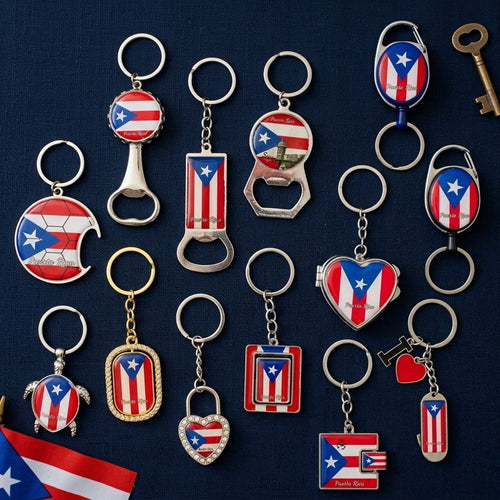


Shop this guide
The products in this article


10% off orders over $100Automatic in the online cart. No code needed.
Free shipping in Puerto RicoOn orders over $40.
50% off shipping to the U.S.To the contiguous United States.